
✦ The Alphabet of Resonance ✦
“Before a melody can cross the sea of stars, it must first learn to breathe through the quiet grammar of pitch, distance, and harmonic form.”
🌌 I. The Canvas of Sound: Pitch, Clefs, and the Seven Notes
In the quiet sanctuary of the Black Shores, every sound begins as a subtle disturbance in the surrounding medium—a cyclical pressure wave rippling through space. When these vibrations occur at regular, periodic speeds, our senses interpret them not as formless noise, but as pitch.
To chart this auditory realm, human tradition has distilled the infinite continuum of sound into seven foundational letter-names:
C — D — E — F — G — A — B
Across the acoustic landscape, the note $A_4$ (the $A$ above Middle $C$) serves as the universal tuning benchmark of modern music, vibrating at exactly:
$$f(A_4) = 440\text{ Hz}$$
When written upon the five horizontal lines of a musical staff, pitches are guided by two primary beacons:
The Treble Clef (G-Clef): Encircling the second line ($G_4$), it charts the shimmering high frequencies—the delicate flutter of luminous butterflies and crisp piano melodies.
The Bass Clef (F-Clef): Anchored on the fourth line ($F_3$), it maps the resonant low frequencies—the deep, rhythmic undercurrents of the Tethys ocean.
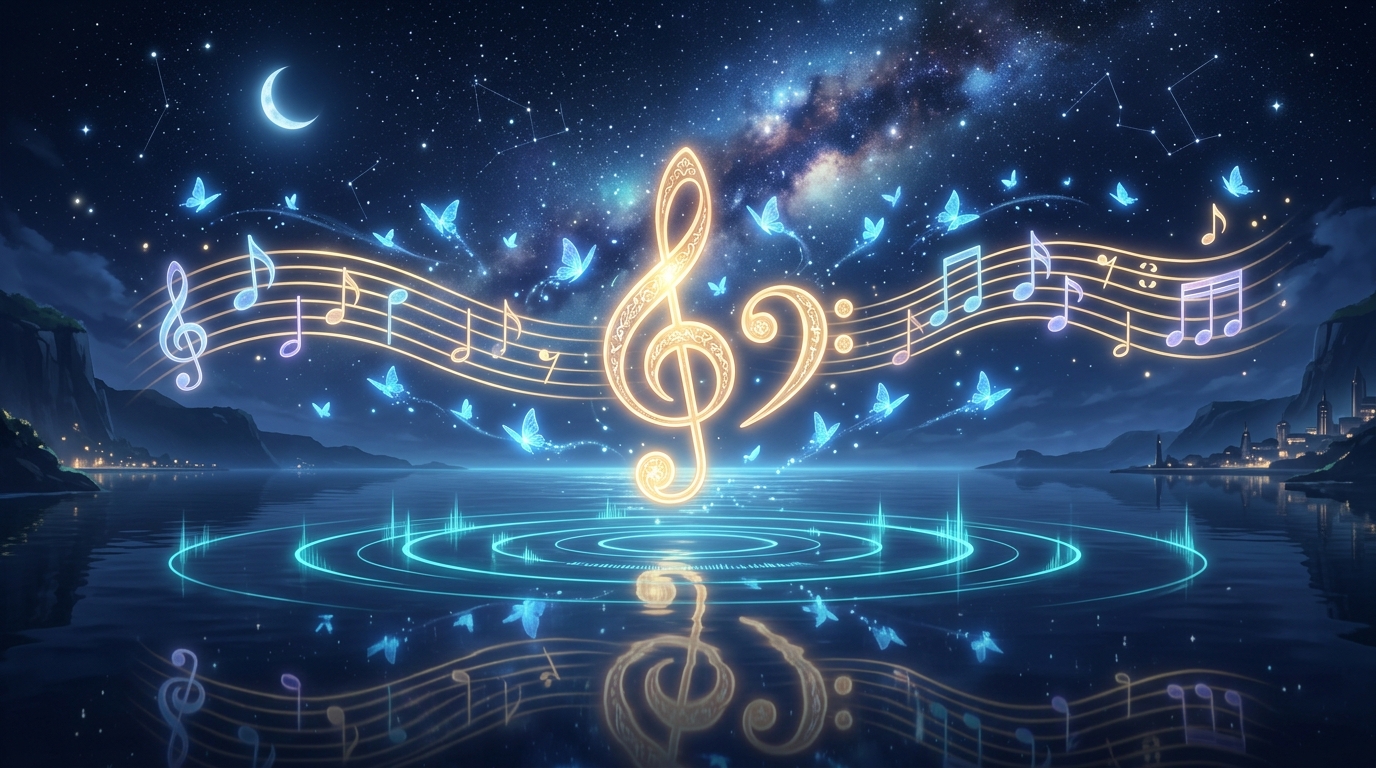
✦ Luminous musical waves and harmonic clefs across the Tethys sea ✦
🦋 II. The Measure of Space: Semitones and Intervals
Just as we measure the vast distances between distant stars in light-years, music measures the distance between two pitches in intervals.
The smallest step in standard Western music is the Half Step (Semitone), denoted as $H$—the distance between any key and its immediate adjacent neighbor on a keyboard (such as $E$ to $F$, or $C$ to $C\sharp$). Two semitones combine to form a Whole Step (Tone), denoted as $W$:
$$1\text{ Whole Step } (W) = 2\text{ Half Steps } (H)$$
When two distinct pitches resonate together, the interval between them dictates the color of their acoustic relationship:
Unison ($1\text{P}$ — 0 semitones): Absolute convergence of identical frequencies.
Minor Second ($2\text{m}$ — 1 semitone) & Major Second ($2\text{M}$ — 2 semitones): Close, friction-laden steps that generate momentum and melodic tension.
Minor Third ($3\text{m}$ — 3 semitones) & Major Third ($3\text{M}$ — 4 semitones): The emotional sculptors of music; they define whether a chord feels sorrowful or radiant.
Perfect Fourth ($4\text{P}$ — 5 semitones) & Perfect Fifth ($5\text{P}$ — 7 semitones): The open, stable pillars that support nearly all harmonic movement.
Octave ($8\text{P}$ — 12 semitones): The miraculous cycle where a note doubles in frequency ($2:1$ ratio), sounding identical in spirit yet higher in realm.
🎼 III. The Architecture of Mood: Major and Minor Scales
A scale is an ordered sequence of notes ascending or descending through an octave. It acts as a palette of light, establishing the emotional atmosphere of a composition.
1. The Major Scale (Radiant and Expansive)
Constructed using the step formula:
$$\text{Major} = W - W - H - W - W - W - H$$
Starting on $C$, this yields the pure white-key sequence:
$C \xrightarrow{W} D \xrightarrow{W} E \xrightarrow{H} F \xrightarrow{W} G \xrightarrow{W} A \xrightarrow{W} B \xrightarrow{H} C$
Its character is open, luminous, and resolute—evoking the first rays of dawn breaking over the sanctuary shores.
2. The Natural Minor Scale (Introspective and Serene)
Constructed using the step formula:
$$\text{Minor} = W - H - W - W - H - W - W$$
Starting on $A$, it shares the exact same pitch collection as $C$ Major ($A, B, C, D, E, F, G, A$), making $A$ Minor the relative minor of $C$ Major. Yet, because its tonal center shifts to $A$, its mood transforms into deep contemplation, reflecting the quiet depths of midnight waters.
💠 IV. Weaving Harmony: Triads and Chord Progressions
While a single note represents a lone point of starlight, a chord is an entire constellation. When three notes are stacked in intervals of thirds, they form a triad.
“A chord is not merely three sounds played at once; it is three distinct frequencies finding a common equilibrium in time.”
Within any musical key, chords perform distinct structural roles. The three primary pillars are:
Tonic ($\text{I}$): The home center of total stability and rest.
Subdominant ($\text{IV}$): The outward departure into narrative journey.
Dominant ($\text{V}$): The peak of harmonic tension that yearns to resolve back home ($\text{V} \to \text{I}$).
🧭 V. The Celestial Compass: The Circle of Fifths
If you ever find yourself adrift across tonal landscapes, the Circle of Fifths serves as the navigator's chart.
By arranging all twelve chromatic pitch classes in a circular clock where each step clockwise ascends by a Perfect Fifth ($7$ semitones):
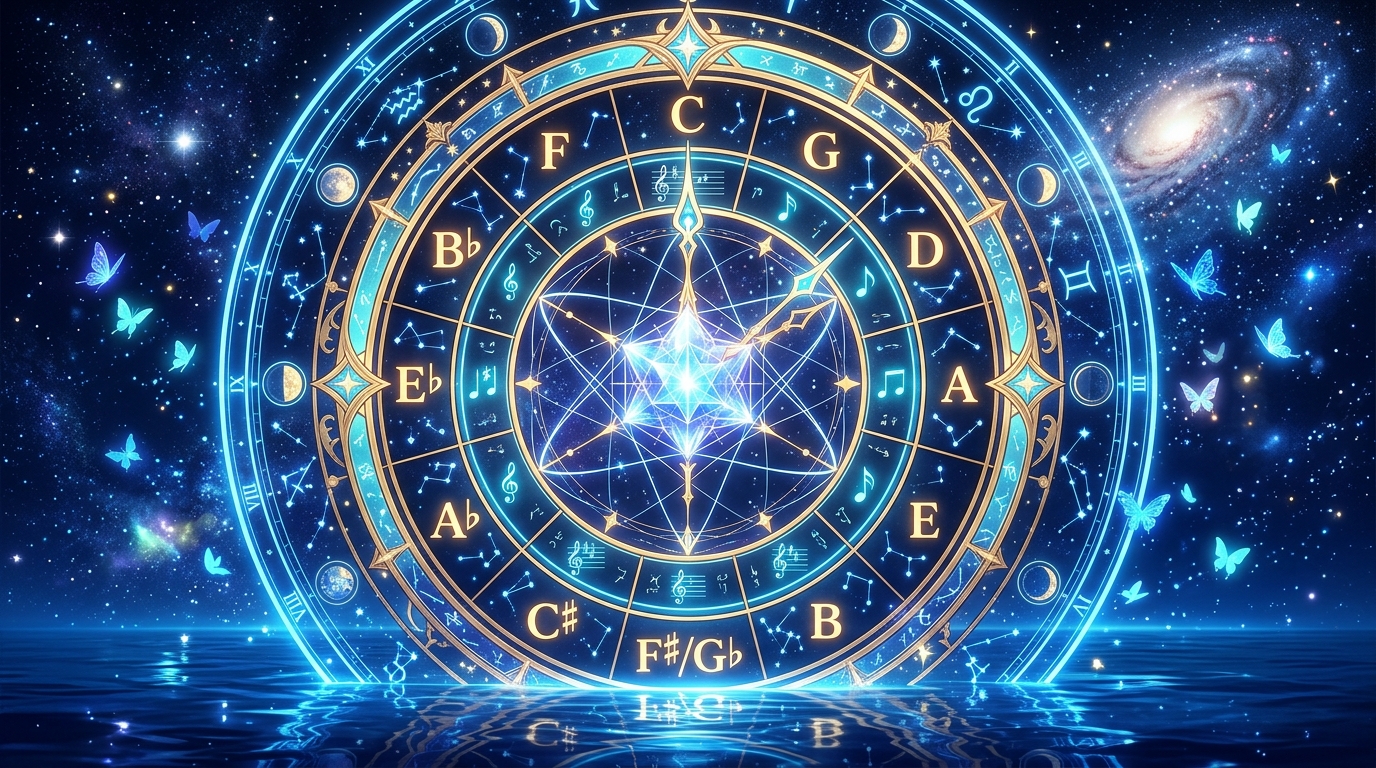
✦ The Celestial Circle of Fifths: Navigating the 12 chromatic tonal centers ✦
C → G → D → A → E → B → F♯/G♭ → D♭ → A♭ → E♭ → B♭ → F → C
Moving clockwise adds one sharp ($\sharp$) to the key signature, lifting the acoustic brightness.
Moving counter-clockwise (by Perfect Fourths) adds one flat ($\flat$), deepening the tonal warmth.
It illustrates why closely adjacent keys share almost identical notes, allowing gentle and seamless modulation between melodic themes.
✨ VI. From Fundamentals to Deep Mathematics
You now hold the foundational grammar of sound: from the gentle vibration of a single pitch to the geometric architecture of scales, intervals, and harmonic pillars.
With these principles illuminated, you are ready to venture deeper into the mathematical cosmos beneath the piano's soundboard—where standing waves, logarithmic frequencies, and Fibonacci spirals converge:
✦ Continue to: The Mathematical Architecture Behind Piano Harmony ✦
Let these gentle frequencies guide your steps, my Roving Star.

Comments